
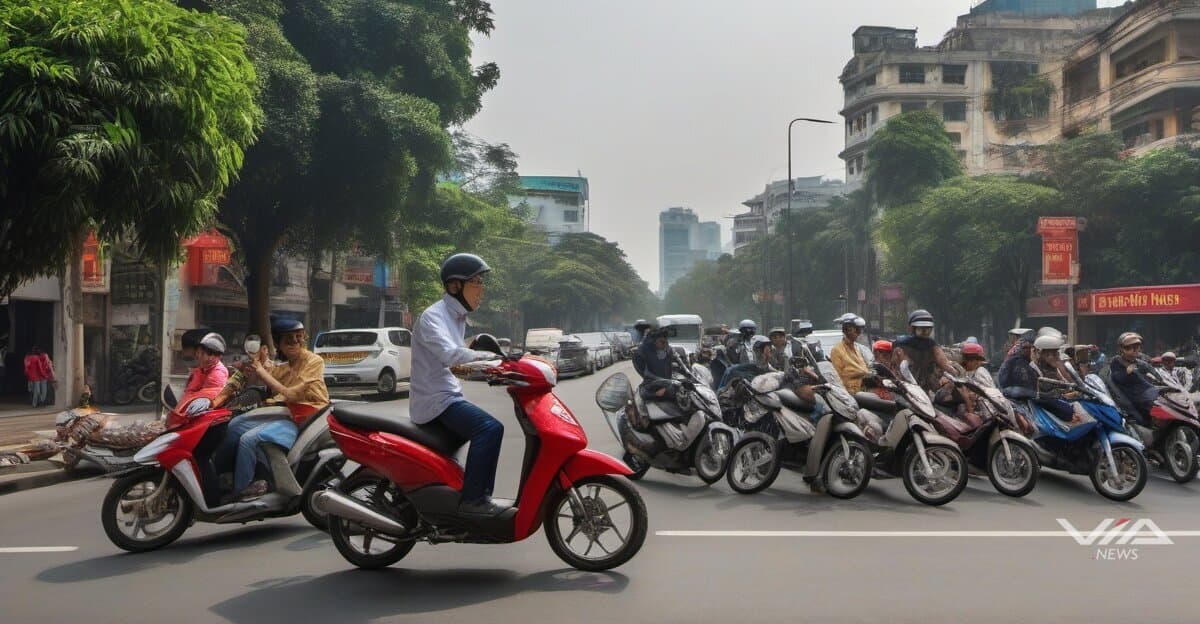
When European cities debate low-emission zones, congestion charges, and phased combustion-engine bans, the conversation tends to stay within familiar boundaries — Amsterdam, Oslo, Paris, Stockholm. But a policy announced from Southeast Asia deserves a place at that table. Hanoi, a city of more than eight million people and home to an estimated four million registered motorbikes, has confirmed it will impose a full ban on fossil fuel motorcycles and scooters inside its urban core by 2030.
The scale of the challenge is difficult to overstate. Unlike European capitals, where car ownership dominates and public transit networks are relatively mature, Hanoi's mobility culture is built on the two-wheel combustion engine. Motorbikes account for the overwhelming majority of daily journeys in the city, and petrol-powered scooters are simultaneously the cheapest, most flexible, and most polluting form of urban transport available to residents.
Yet that is precisely what makes the 2030 deadline remarkable — and relevant. European cities have largely pursued incremental transitions, phasing out diesel vehicles first, then expanding zero-emission zones gradually. Hanoi is moving toward a hard deadline affecting the most democratically accessible form of transport its citizens possess. If implemented effectively, the policy would eliminate a primary source of the city's chronic air pollution, which regularly exceeds World Health Organisation safe limits by a factor of three or more during peak periods.
The announcement draws direct comparisons to European green city initiatives. Oslo has committed to becoming the world's first zero-emission city for short sea shipping and urban delivery by 2030. Amsterdam is eliminating petrol and diesel cars and mopeds from the city centre by the same year. Brussels has already introduced one of the continent's strictest low-emission zones. What these cities share with Hanoi is a recognition that urban air quality is a public health crisis requiring regulatory force, not merely market incentives.
The electrification infrastructure question looms large in both contexts. Gogoro, the Taiwanese battery-swapping company whose recent earnings results brought renewed attention to Southeast Asian EV markets, has positioned its swappable-battery ecosystem as a practical solution for dense Asian cities where home charging is largely impossible. The model — users swap a depleted battery for a charged one at a kiosk in under a minute — has found traction in Taiwan and is being evaluated across the region. European counterparts are watching: similar battery-swap concepts have been proposed for cargo bikes and last-mile delivery fleets in cities including Hamburg and Rotterdam.
Critics of Hanoi's timeline point to the socioeconomic gap between aspiration and execution. Affordable electric two-wheelers remain out of reach for a significant portion of the city's working population, and the charging and swapping infrastructure required to serve millions of daily commuters does not yet exist at scale. Subsidy programmes and financing schemes will be essential — a lesson European policymakers learned early in their own EV transitions.
But for urban sustainability planners across Europe, the Hanoi ban is a signal worth heeding. It demonstrates that fossil fuel phase-outs are no longer a conversation confined to wealthy northern democracies with established green-energy grids. When a rapidly developing megacity sets a hard 2030 deadline on its most ubiquitous transport mode, the political calculus in Berlin, Rome, or Warsaw shifts — because the argument that such transitions are simply too disruptive, too soon, becomes considerably harder to sustain.