
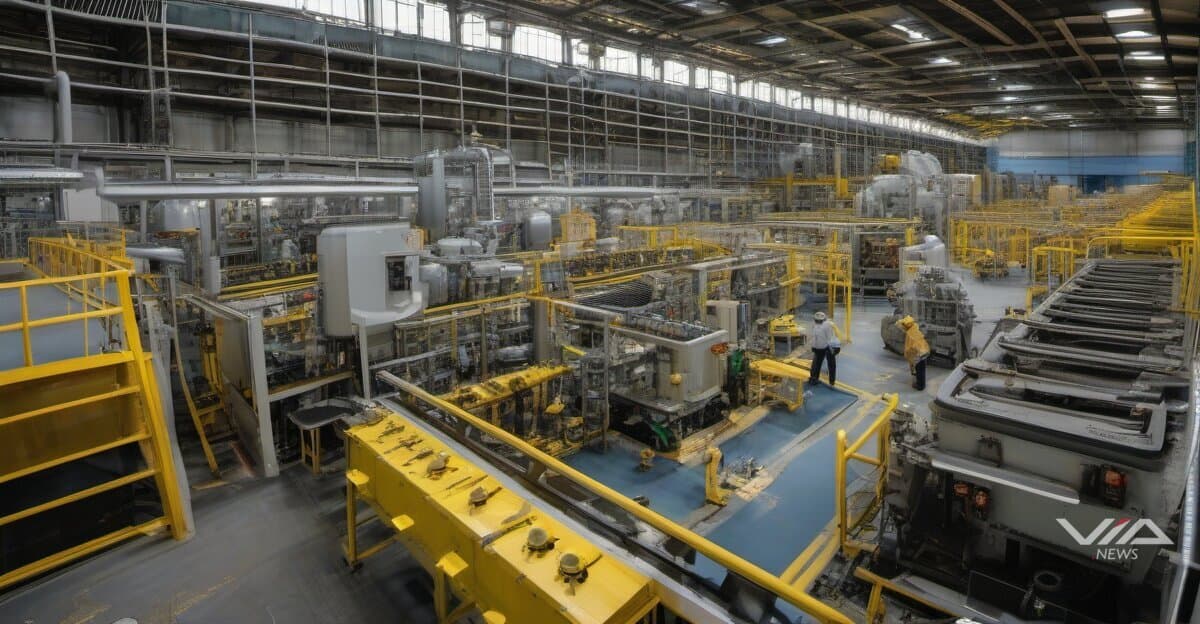
When ProLogium Technology inaugurated the world's first giga-level solid-state battery factory in Taoyuan, Taiwan, it marked a genuine technological milestone. The company has positioned itself at the frontier of next-generation energy storage — a technology that promises to transform electric vehicle range, charging times, and safety. European automakers, from Stellantis to Mercedes-Benz, have taken notice, signing partnership agreements that implicitly tie portions of their electrification roadmaps to ProLogium's output.
But the geography of that achievement carries a consequence that is only now entering mainstream European policy debate: the world's most advanced solid-state battery production capacity sits in a jurisdiction that security analysts increasingly flag as one of the highest-risk geopolitical flashpoints on earth.
Cross-strait tensions between Taiwan and mainland China have intensified through 2024 and into 2026, with military exercises, diplomatic friction, and export control measures creating a persistent undercurrent of uncertainty. The United States, Japan, and the European Union have each published strategic risk assessments acknowledging that a disruption — whether through conflict, blockade, or targeted export restrictions — to Taiwan's industrial base would cascade through global supply chains with speed and severity that few contingency plans are designed to absorb.
For Europe, the stakes are particularly acute. The EU's own risk modelling, embedded within the Critical Raw Materials Act framework and the European Battery Alliance's strategic roadmap, consistently identifies supply chain concentration as the primary structural vulnerability in the bloc's green transition. The battery sector is the nerve centre of that vulnerability: Europe currently imports the overwhelming majority of its lithium-ion cells from Asia, and solid-state technology was supposed to offer a path toward greater domestic value creation.
ProLogium's Taoyuan facility complicates that narrative. With an assessed severity rating of catastrophic and a medium likelihood of disruption — representing a confluence of military, political, and regulatory scenarios — the concentration of cutting-edge production capacity in a single jurisdiction amplifies rather than reduces Europe's exposure. A disruption to Taoyuan output would not merely slow EV production lines in Wolfsburg or Sochaux; it would set back the entire European solid-state battery technology curve by years, at precisely the moment when Chinese domestic manufacturers are scaling their own next-generation capacity.
The European Commission has acknowledged the problem in broad terms. The Net-Zero Industry Act includes provisions intended to stimulate domestic battery gigafactory investment, and the European Battery Alliance has catalogued over 40 planned or active large-scale battery projects across member states. Yet solid-state technology — as distinct from conventional lithium-ion — remains dramatically underfunded in European public and private investment flows, with the bulk of serious capital deployed in Asia.
Industry observers argue that the ProLogium situation should function as a policy accelerant. "Europe needs to treat solid-state battery manufacturing capacity with the same strategic urgency it now applies to semiconductor fabrication," said one Brussels-based energy transition analyst. "The Taiwan lesson from semiconductors — that we waited too long and paid an enormous price — is being repeated in slow motion with batteries."
For European policymakers, the implication is clear: partnership agreements with Taiwanese manufacturers are commercially rational, but they are not a substitute for resilient domestic capacity. The Taoyuan gigafactory's existence proves the technology is scalable. The question now is whether Europe will invest seriously enough, and quickly enough, to ensure that proof of concept translates into European production before geopolitical risk transforms into supply chain reality.