
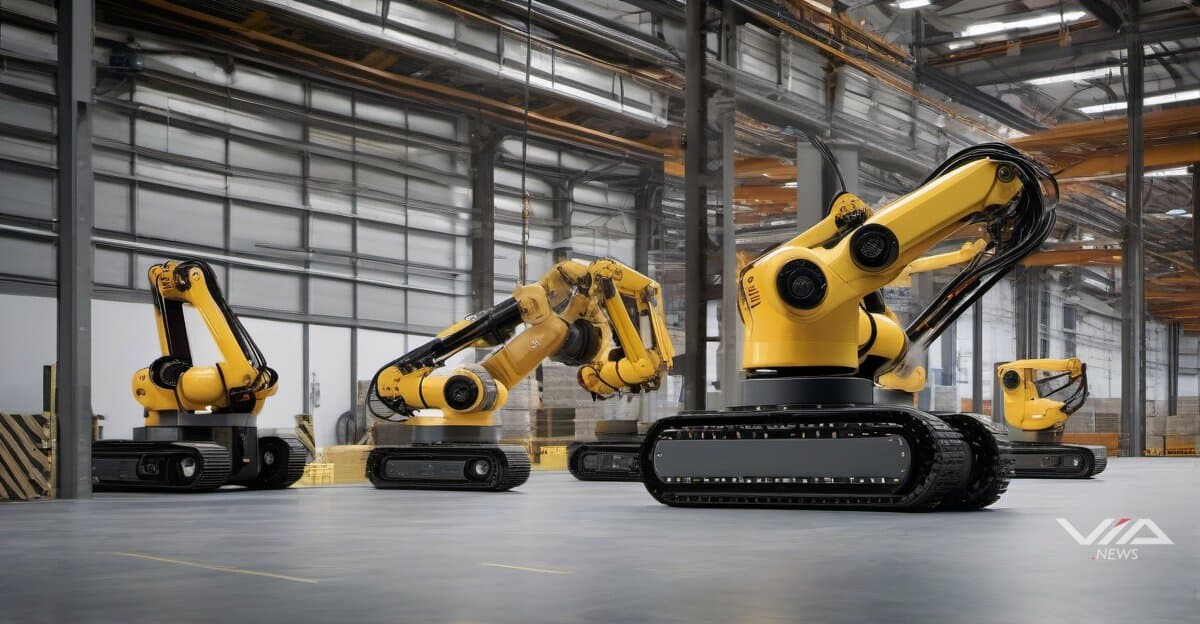
Chinese robotics manufacturers are capturing warehouse automation contracts at prices 60% below European industrial equipment suppliers, compressing deployment cycles that traditionally required years into months-long implementations.
"In Saudi Arabia's digital transformation, Chinese robots are already supporting high-tech sectors such as logistics, smart manufacturing, healthcare, and smart city services," said Mohammed Alsolami, noting systems now pilot and scale "in months instead of years, which is exactly what Saudi Vision 2030 requires."
The cost advantage extends beyond hardware. Nomagic's Shoebox Picker handles more than 98% of market shoeboxes while Polish startup competitor Nomagic raised seed funding to deploy "physical AI into the heart of warehouse and logistics operations," according to co-founder Kacper Nowicki.
European automation giants including ABB, Siemens, and KUKA built dominant positions through decades of manufacturing expertise and premium pricing. Chinese entrants are now leveraging foundation models and standardized autonomous systems to deliver comparable accuracy at fraction of legacy costs.
The autonomous guided vehicle (AGV) market illustrates the shift. Traditional European AGV suppliers sell custom-engineered systems requiring extensive integration. Chinese manufacturers offer plug-and-play units with AI-driven navigation that reduce deployment complexity.
Talent migration signals broader industry transformation. Engineers from OpenAI and Apple have moved to robotics startups, bringing AI-first approaches that prioritize software intelligence over mechanical precision. This shift favors rapid iteration cycles where Chinese manufacturers excel.
Nuro's autonomous vehicle platform demonstrates physical AI maturation beyond warehouses. The company's "safety and validation framework honed over years of commercial autonomous deployments" shows physical AI scaling from controlled environments to public roads.
European firms face strategic choices: compete on price by relocating production, or defend premium positioning through proprietary AI models and vertical integration. Mid-market players risk margin collapse as customers opt for low-cost Chinese systems or high-capability European platforms.
"Chinese robotics is playing a clear role in narrowing the technology gap globally," Alsolami said, describing how accessible automation enables emerging markets to leapfrog traditional industrial development paths.
The warehouse robotics segment represents immediate competitive pressure, but automotive, healthcare, and consumer applications face similar cost disruption as Chinese manufacturers scale physical AI across sectors.