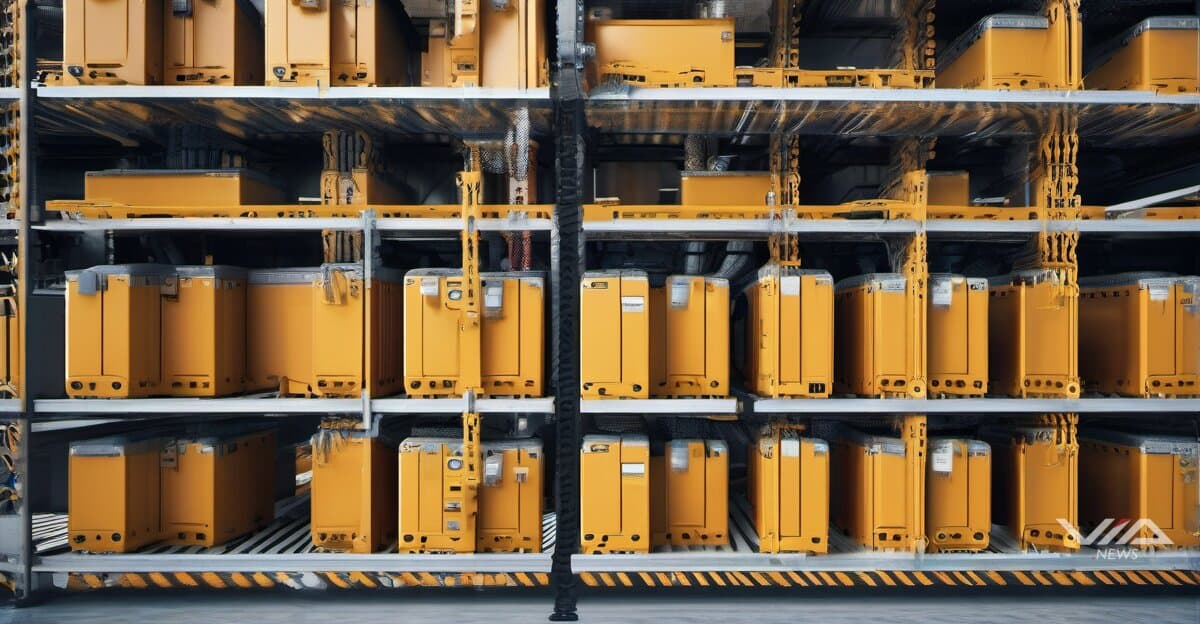
The strongest fact: one memory maker's spending has tripled
Much of the mid-2026 market story is analyst opinion. The firmest number we have is not opinion. Micron Technology's capital expenditure for the first quarter of its 2024 fiscal year was $1.796 billion, and for the first quarter of fiscal 2025 it was $3.206 billion.1 For the first quarter of fiscal 2026 it was $5.389 billion, three times the level of two years earlier.1 The full-year figures tell the same story. Capex was $7.676 billion in FY 2023 and $8.386 billion in FY 2024, then $15.857 billion in FY 2025.1 That is almost double in a single year. All of these figures come from SEC filings and have been checked against them.
To picture $15.9 billion: Baker Hughes, the energy-equipment group, forecasts $27.35 billion of revenue for all of 2026.4 Micron's one-year capex is well over half of that.
A note on what is, and is not, European here
Our editorial brief for this publication is to lead with the European angle. The honest position is that the dossier contains almost no EU regulation or EU-company financials. We found no EU rule, regulator or policy decision tied to this theme, and we will not invent one. Names a European reader will know do appear. They are ASML, UBS and the Carlsberg and Kronenbourg 1664 beer brands. We cover each below, but the evidence about them is thinner than the evidence about Micron.
If you hold a global index fund, you may already own some of these companies. The dossier does not give index weightings, so we cannot say how much.
Why memory matters: who Micron sells to
Our entity data records Micron as a supplier to Amazon Web Services and to Meta Platforms, and as located in Taiwan.15 Sandisk, another memory name in the story, was spun off from Western Digital, which owns it.15 On 4 September 2026, Lynx Equity Strategies analyst K.C. Rajkumar published a bullish analysis rating both Micron and Sandisk as clear buys.14 The same day ASML's stock rose over 4% in what the record describes as a sympathy rally.14 A European chip-equipment name therefore moved on an American analyst's note about memory chips. That shows how tightly the group trades together. It does not show that ASML's own business changed.
What the filings say about the cash and the costs
Micron's cash rose from $10.163 billion in the third quarter of fiscal 2025 to $24.995 billion in the third quarter of fiscal 2026.2 That is about 2.5 times the earlier figure. It is also close to Baker Hughes' whole forecast 2026 revenue.2,4 Earlier, cash had moved within a narrower range. It was $9.298 billion in Q3 2023, $7.594 billion in Q3 2024 and $13.908 billion in Q2 2026.2
Cost of revenue, what it costs the company to make what it sells, grew far more slowly than capex. It was $19.498 billion in FY 2024 and $22.505 billion in FY 2025, up about 15%.3 In the first quarter it was $5.361 billion in 2025 and $5.997 billion in 2026, up roughly 12%.3 The dossier holds no revenue figures for Micron, so we cannot calculate profit margins and do not try. The gap does show that Micron's spending on future capacity is growing much faster than the cost of its current output. That is the pattern of a company building ahead of demand.
The power leg of the trade
The wider thesis, as Via News's narrative record puts it, is that sell-side activity centres on the AI infrastructure buildout. It lists Digital Realty raising core FFO guidance and Evercore ISI setting a Street-high $350 target on Bloom Energy.5 FFO is the profit measure property companies report.
On Bloom, one commentator, Nicholas Amicucci, wrote that its ability to provide reliable, dispatchable power to a volatile demand profile differentiates it from competitors.6 Treat that with care. The source, "Bull of the Day: Bloom Energy (BE)", had only 46% of 520 checked claims hold up under our measurement, the weakest record of any commentary source here.6
Baker Hughes is a harder data point. Its CEO said orders in its industrial and energy technology unit doubled year on year to a record $7.1 billion.4 The company targets orders above $45 billion for its next phase.4 The excerpt we hold does not say how much of this is data-centre demand, so we do not claim a link.
NuScale, the small-reactor developer, is a cautionary case. Its shares have fallen nearly 40% this year. Bank of America analyst Rinny Singh reiterated a buy in early August with a $12 target, implying about 24% upside.7 That article comes from a source where only 22% of 18 checked claims held up, so the sample is small and the record poor.7
Where the story looks stretched
D-Wave Quantum closed at $17.64 on 28 July after falling about 10% following a 20% surge the day before. It was still down 25% over the month.8 Analyst Melissa Tucker put the stock at 171 times its sales. She projected 2026 revenue near $35 million and a fair value of $9.50 a share, and cited a delayed technology roadmap.8 She called that roughly 40% downside from current levels.8 Our own arithmetic does not match. $9.50 against the $17.64 close is a drop of about 46%, so the analyst's figure was probably set against a different price. The direction is clear, but treat the exact percentage as unverified.
Our narrative record also notes that SpaceX shares are down more than 40% from their highs.5 Our entity data lists the SEC as its regulator and OpenAI and Anthropic as competitors.15 We have no figures behind that comparison.
The consumer side, and the European banks
Nike is the clearest case. Bank of America's Lorraine Hutchinson lowered the price target because Nike's sales recovery is taking longer than expected.10 Wendy's fell nearly 6% on 16 September after Seaport Global's Eric Gonzalez initiated coverage with a neutral rating. The fall added to a decline since a take-private plan collapsed.11 The dossier also names GAP and Levi as weak on traffic, but offers no figures for them.5
For a European reader, UBS is a counterweight. Its results came with a $3 billion buyback, and analyst Anke Reingen said "UBS reported a strong set of results, not unexpected post peer results".9 She added "The top line benefited from supportive markets and operating leverage meant a large part went through to profits."9 That is a bank profiting from busy markets, not from AI hardware. The dossier gives no reliability measure for this source.
Beer shows how consumer brands are being repositioned. From 1 January 2027, Tilray will brew, market and sell Carlsberg, Carlsberg Elephant 1664 and Kronenbourg 1664 Blanc across the U.S.14
Biotech: a different story
Biotech is only loosely tied to the AI theme. JPMorgan's Jessica Fye said several important trends are developing at once in large-cap biotech: improving profitability, broader commercial diversification, steady clinical catalysts and continued business development.13 On 24 September Goldman Sachs analyst Andrea Newkirk resumed coverage of Iovance Biotherapeutics with a buy and a $15 target, and the shares rose.12 A dated catalyst follows. The FDA has set 14 November 2026 as the target decision date for Summit Therapeutics' ivonescimab application.14
What to watch
- Whether Micron's capex keeps climbing toward and beyond the first-quarter run rate of $5.389 billion, and whether its cost of revenue follows.1,3
- Whether Micron's $24.995 billion of cash is spent on capacity or kept.2
- Whether Baker Hughes' record orders keep converting to revenue against its $27.35 billion forecast.4
- D-Wave's next results and whether the 171x multiple can be justified by actual revenue.8
- The 14 November FDA date for ivonescimab.14
Most of the commentary behind this theme comes from sources where roughly half or fewer of checked claims held up, between 22% and 57%.4,6,7,10 The Micron filings are the most dependable evidence here, and what they establish is spending, not demand. Whether the demand is there is the question the next few quarters will answer.